
Oregon Family Law and Divorce Law Blog
Showing all 225 posts in random order
Schedule A Consultation
We are happy to meet with you for a flat-fee, discounted consultation. Call today.
Call Now to Schedule A ConsultationSchedule Online Now


Do restraining orders carry over from state to state?
Restraining orders, also sometimes called "FAPA orders" or "protective orders" in Oregon, can be received in any state. However, they can still be enforced when you or the protected person are located in another state. A restraining order issued against you in Oregon is still valid in other states, and you must follow the terms.
Read More
Should You Leave the Family Home During an Oregon Divorce?
Deciding whether to leave the family home during a divorce in Oregon involves strategic considerations. Learn how this decision can impact custody and property disputes.
Read More
Understanding Temporary Protective Orders and Status Quo Orders in Oregon Child Custody Cases
Explore the distinctions between Temporary Protective Orders of Restraint (TPOR) and Status Quo Orders (SQO) in Oregon, crucial tools for maintaining stability during custody proceedings.
Read More
Understanding Divorce and Legal Separation in Oregon
Explore the differences between divorce and legal separation in Oregon, including legal implications and considerations for couples.
Read More
Navigating Debt Division in Oregon Divorce Proceedings
Explore how marital debts are divided during divorce in Oregon, including common pitfalls and the equitable distribution approach. Learn how courts assign debts and what to expect if your ex-spouse defaults on payments.
Read More
Preparing for Your Oregon Divorce Consultation: Five Essential Tips
Before pursuing a divorce in Oregon, consulting with an experienced attorney is crucial. Here are five tips to ensure your consultation is productive and informative.
Read More
Dissolving a Domestic Partnership in Oregon: A Comprehensive Guide
Learn about the process of dissolving a domestic partnership in Oregon, including filing requirements, property division, and partner support options.
Read More
Avoiding Financial Pitfalls in Oregon Divorce Proceedings
Navigating divorce in Oregon requires strategic planning to avoid costly financial errors. Transparency and informed decision-making are crucial for a fair outcome.
Read MoreUnderstanding Oregon's Three Types of Spousal Support
Oregon law recognizes three distinct types of spousal support: transitional, compensatory, and spousal maintenance. Each serves a unique purpose in addressing financial disparities post-divorce.
Read More
Understanding the Best Interests of the Child in Oregon Custody Cases
In Oregon, determining a child's best interests is central to custody decisions. This article explores how courts evaluate these interests and offers guidance for parents.
Read MoreRecent Posts

Uncontested Summary Dissolution in Oregon: Do You Qualify for the Simplest Divorce?
circuit court clerk
eligibility criteria
filing fee
filing for summary dissolution
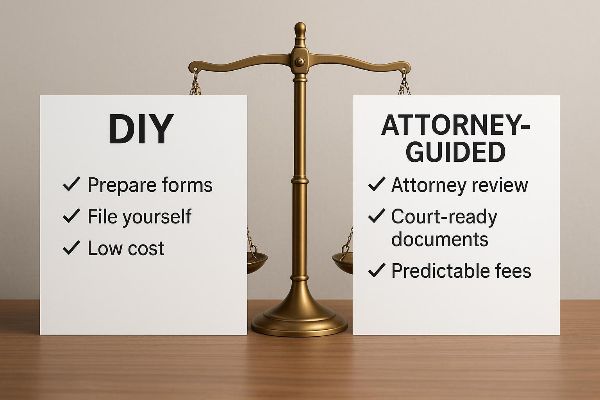
DIY vs. Attorney‑Guided Uncontested Divorce in Oregon: Cost, Risks & When to Get Help
attorney-guided
attorney-guided review
business interests
child

Uncontested Divorce in Oregon: The Complete 2025-2026 Guide
attorney fees
child custody
child support worksheets
co-petitioners

Introducing Unlink: The Oregon‑Smart Way to Divorce Amicably
attorney fees
contested divorce
court hearings
custody
Understanding Oregon's Three Types of Spousal Support
alimony
child custody
compensatory spousal support
dissolution process