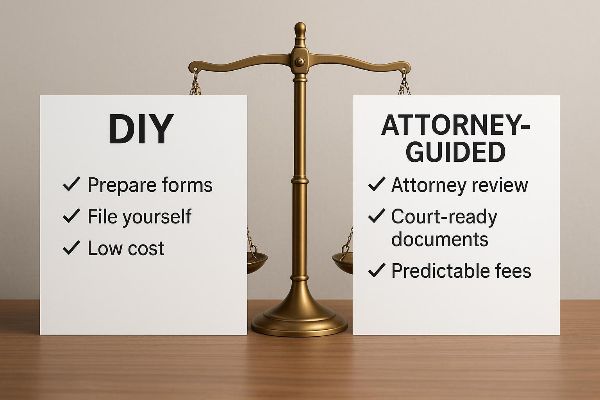
Do I need an attorney for my Oregon divorce?
While it is not required to have an attorney during your divorce process in Oregon, having legal representation can be beneficial as they will ensure your best interests are protected and guide you through complex legal processes involved in matters like property division, child custody arrangements, and spousal support.
Can I get spousal support (alimony) in an Oregon divorce?
Spousal support may be awarded depending on factors such as length of marriage, each spouse's income and earning capacity, contributions made during marriage (including homemaking), and financial needs of both parties.
What happens if we don't have a prenup and decide to divorce?
Without a prenup, Oregon's default divorce laws apply. Oregon is an 'equitable distribution' state, meaning marital property is divided fairly but not necessarily equally, based on factors like the length of the marriage and each spouse's contributions.
How are assets divided during an Oregon divorce?
Oregon follows an equitable distribution model when dividing assets during a divorce; this means property will be divided fairly but not necessarily equally between spouses. Courts consider factors like income potential, contribution to acquisition or preservation of assets, length of marriage, and tax consequences when determining how to divide property.
How is property divided in an Oregon divorce?
Oregon follows an 'equitable distribution' model, which means marital assets are divided fairly but not necessarily equally between spouses. Factors such as each spouse's contribution to the marriage and earning potential will be considered.
How is spousal support determined in Oregon?
In Oregon, the court determines spousal support based on factors such as the duration of the marriage, each spouse's income and earning capacity, contributions to homemaking or education during marriage, and age and health of both parties.
How are retirement accounts handled in an Oregon high asset divorce?
Retirement accounts, such as pensions and 401(k)s, are treated as marital property and subject to equitable distribution during an Oregon high asset divorce. The court may use a Qualified Domestic Relations Order (QDRO) to allocate portions of retirement benefits between the parties upon the account holder's retirement or withdrawal.
Will I be required to pay alimony in an Oregon high asset divorce?
In a high asset divorce, alimony (spousal support) may be awarded based on factors like the length of the marriage, each spouse's income and earning capacity, contributions to career advancement or education, and standard of living during the marriage. The amount and duration of support will vary depending on specific case details.
How are assets divided in an Oregon high asset divorce?
Oregon is an equitable distribution state. This means that marital assets are divided fairly and equitably between the divorcing parties, taking into consideration factors like each spouse's earning capacity and contributions to the marriage. This does not necessarily mean a 50/50 split; rather it depends on what the court deems fair under the circumstances.
How does having a prenuptial or postnuptial agreement affect a high asset divorce?
A prenuptial or postnuptial agreement can greatly impact how assets are divided in a high asset divorce by predetermining how specific properties and financial interests will be allocated upon separation. These agreements can simplify property division issues during the divorce process if validly created and enforceable under Oregon law.
How does spousal support work in Oregon?
Spousal support (also known as alimony) may be awarded based on factors such as length of marriage, financial resources of each party, earning capacities, standard of living during marriage, and contributions made by one party towards education or career advancement opportunities for the other party. There are three types: transitional (short-term), compensatory (reimbursement), and maintenance (long-term). Spousal support amounts and duration are determined at a judge's discretion.
How do business interests factor into an Oregon high asset divorce?
In an Oregon high asset divorce involving business interests, professionals will often be enlisted to accurately value the business so it can be fairly distributed as part of marital property. If spouses co-own businesses together or if one spouse contributed significantly to its growth during marriage, more intricate evaluations may be required for equitable division.