Blog

Understanding Wedding Ring Ownership in Oregon Divorces

In Oregon, wedding rings are often considered separate property due to their personal nature and donative intent. This article explores the legal nuances surrounding this issue.

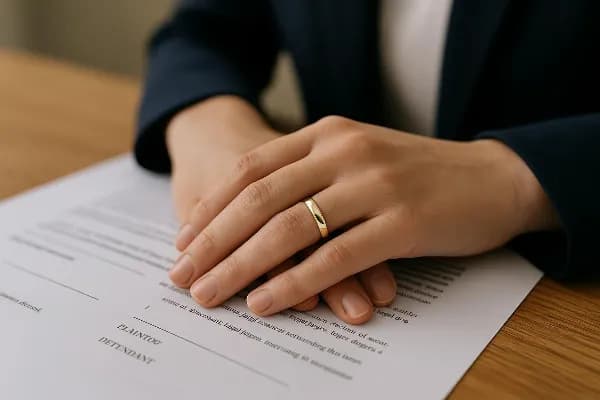
A close-up image of a woman's hand wearing a wedding ring, resting gently on a legal document. The document features visible text and legal jargon, suggesting its relevance to divorce proceedings. The focus is on the ring, symbolizing its significance in

Oregon family law context

Use this article as general information to understand the issue, preserve useful records, and identify the next questions to ask an attorney about your own facts.


Published June 12, 2025

Understanding Wedding Ring Ownership in Oregon Divorces

When navigating the complexities of divorce, one question that frequently arises is whether a spouse can retain their wedding ring. In Oregon, the determination of ownership hinges on whether the item is considered part of the " marital estate " or as separate property.

The Marital Estate vs. Separate Property

Under Oregon law, assets acquired during a marriage typically fall within the " marital estate, " subject to equitable distribution upon divorce. However, exceptions exist for items deemed to be gifts that carry a personal nature. Since 2005, a pivotal case has shaped this understanding: In re Marriage of Mallorie, 200 Or App 204 (2005) .

The Mallorie Case: A Precedent for Personal Gifts

The ruling in Mallorie provided clarity by emphasizing two critical factors:

  1. Gift Status: The item in question must be clearly identified as a gift from one spouse to another.
  2. Personal Nature: The item should be uniquely suited to one spouse’s use.

The court concluded that if an item meets these criteria—such as clothing or jewelry—it should be considered separate property rather than part of the marital estate.

Application to Wedding Rings

Applying this legal framework specifically to wedding rings, if such a ring was given as a gift and is uniquely suited for one spouse's use, it is generally treated as separate property. This means that regardless of when or how it was acquired during the marriage, it remains with the recipient post-divorce. For example, consider a scenario where one spouse purchases an engagement ring before marriage and presents it as a gift; under Mallorie, this would likely remain with the recipient spouse after divorce due to its personal nature and donative intent.

Distinguishing from Other Assets

It's important to note that not all gifted items receive this treatment. For instance, gifting an automobile does not render it separate property since vehicles are not inherently personal or unique to one individual's use within a marriage context.

Conclusion: Consult with an Attorney for Clarity

While Mallorie provides guidance on handling wedding rings in divorces, each case presents unique circumstances requiring careful analysis. We recommend consulting with an experienced Oregon family law attorney at Pacific Family Law Firm who can provide tailored advice based on specific details of your situation.

Clear advice before the process gets louder

Family transitions can bring court deadlines, financial uncertainty, parenting questions, and strong emotions at the same time. The first job is to steady the situation, understand the facts, and identify the legal options that fit your family.

Schedule a Consultation

Client perspective

I have known Adam on both a professional and personal level for years and trust his judgment and expertise completely. I often recommend him to clients and would not hesitate to recommend him to a friend in need...

Jacob Braunstein, Attorney

I Trust [Adam'S] Judgment And Expertise Completely

Past results do not guarantee a similar outcome.

Representative result

Case outcomes are shared only when they can be presented accurately and with the right context.

Information submitted through this site does not create an attorney-client relationship. Representation is confirmed only in writing.

Related reading

  • DIY vs. Attorney‑Guided Uncontested Divorce in Oregon: Cost, Risks & When to Get Help

    Thinking about a do‑it‑yourself uncontested divorce in Oregon? This guide compares DIY and attorney‑guided options, highlights real cost drivers and risks, and shows when a brief attorney review can help prevent costly mistakes.

    Learn more
  • Uncontested Divorce in Oregon: The Complete 2025-2026 Guide

    Uncontested divorces provide Oregon couples with a quicker, more cost-effective way to end their marriage peacefully. This comprehensive 2025 guide outlines the main requirements, steps, timelines, and costs involved in an uncon affordable way tested divorce in Oregon. Learn how to navigate the process smoothly and find resources to help you complete your divorce confidently.

    Learn more
  • Uncontested Summary Dissolution in Oregon: Do You Qualify for the Simplest Divorce?

    Oregon’s summary dissolution is the fastest and simplest divorce option for those who qualify. We explain the strict ORS 107.485 criteria – from no kids and a short marriage to limited debts, and how they differ from a standard uncontested divorce. Learn if you meet the requirements and what forms to file for this streamlined process.

    Learn more

Facing a family change?

Talk through the next step