Step-by-Step Checklist for Filing an Uncontested Divorce in Oregon
Filing for an uncontested divorce (sometimes called a "simplified dissolution" or "stipulated divorce") means you and your spouse agree on all issues – division of property and debts, custody and parenting time, child support, spousal support (if any), etc. Without any disagreements to hash out in court, you can follow these steps to complete the divorce relatively smoothly. Here’s a handy checklist:
- Meet the Residency Requirement: Ensure you have the right to file in Oregon. At least one spouse must be an Oregon resident. If the marriage took place outside Oregon, the Oregon-resident spouse must have lived in Oregon continuously for 6 months before filing oai_citation:1‡law.justia.com. (If you were married in Oregon, it's enough that one of you lives in Oregon now oai_citation:2‡law.justia.com.) Also, Oregon is a “no-fault” state – the only ground for divorce is “irreconcilable differences,” so you don’t need to prove any misconduct.
- Decide on Solo Petition vs. Co-Petition: In Oregon, you have the option to file as a sole petitioner or as co-petitioners with your spouse.
- Solo (Single Petitioner): One spouse files the petition and is the “petitioner,” and the other is the “respondent.” In an uncontested case, the respondent can sign an acceptance of service and even a stipulated judgment agreeing to all terms, instead of filing a response. This approach requires formal service of the papers (unless the respondent signs a notarized Acceptance of Service).
- Co-Petitioners: Both spouses sign and file the petition together. This joint filing approach means there is no “respondent” and no need for service of process, since both parties are notifying the court together that they want the divorce. Co-petition can simplify and speed up the process when both spouses are fully cooperative.
Complete the Required Forms: Obtain the official Oregon divorce forms for a dissolution of marriage. For an uncontested divorce, you will typically need:
- Petition for Dissolution of Marriage/RDP: This is the main form where you list information about the marriage and the agreements (custody, property division, etc.). There are different versions if you have children vs. no children. (Use the “co-petition” version if filing jointly.)
- Summons: Required if you are filing solo. The summons is issued by the court clerk and will need to be served on the other spouse.
- Confidential Information Form (CIF) & Notice of Filing CIF: These forms safeguard sensitive personal information (like Social Security numbers, dates of birth, employer info) and are filed in every family law case. The notice is a cover page that you filed the confidential info separately.
- Certificate Regarding Pending Child Support Proceedings: If you have children, Oregon law requires a certificate stating whether there are any existing child support orders or pending proceedings (this helps the court ensure consistent child support rulings).
- Parenting Plan: If you have minor children, you must include a parenting plan (as discussed in Post 2). You can attach a detailed plan or use a simplified summary in the judgment, but it’s required by ORS 107.102.
- Settlement Agreement (Marital Settlement Agreement): Though not a court form per se, if you have a written agreement that covers all the terms (sometimes called a Property Settlement Agreement or Marital Settlement Agreement), it can be filed and incorporated into the judgment. In many uncontested cases, the terms are simply written into the petition or judgment instead of a separate agreement.
- Judgment of Dissolution of Marriage: This is the final order that the judge signs to finalize the divorce. You will need to prepare this judgment for the court. It will restate all the terms of your agreement (property division, parenting plan, support obligations, name changes, etc.). Both parties should sign the proposed judgment to indicate it is agreed (stipulated).
You can get all these forms on the Oregon Judicial Department (OJD) Forms page for family law. The OJD offers packets (for divorce with children, without children, etc.) that include instructions. You may also use the OJD’s Guide & File online interview program to generate the forms – this is a free step-by-step questionnaire that produces completed court forms ready to file.
- File the Papers with the Court: Once your forms are filled out, you need to file them in the Circuit Court for the county where either you or your spouse lives (you can choose the county if you live in different counties).
- Electronic Filing (eFile): Oregon allows eFiling for divorce through the OJD eFile system. You can register and upload your documents online, and pay the filing fee electronically. (The eFiling system is available 24/7, though your documents will be officially “filed” during court business hours.)
- Paper Filing: Alternatively, you can file in person or by mail. Take at least two copies of all documents to the courthouse. The clerk will stamp them; one copy will be for you to keep (and one to serve on your spouse if applicable).
- Filing Fee: As of now, the fee for filing a dissolution in Oregon is around $300 (check the current fee schedule for the exact amount in your county). If you cannot afford the fee, you can file an Application for Waiver or Deferral of Fees. The court may allow you to proceed without paying upfront or at all, based on income.
- Serve Your Spouse (if Solo Filing): If you filed a sole petition (not as co-petitioners), Oregon law requires that the other spouse be formally served with the divorce papers. Proper service ensures the respondent has official notice of the case.
- Acceptable Service Methods: The most common method is personal service by a third-party adult (such as a professional process server or any adult who is not you or a party to the case). The server delivers the summons and petition to your spouse and then completes a Proof of Service affidavit for the court file. You can also request the county sheriff’s office to serve the papers (for a fee). If you cannot locate your spouse, you would need court permission for an alternate service method (like publication).
- Acceptance of Service: In an uncontested matter, often the easiest approach is for the respondent to sign a notarized Acceptance of Service form, which acknowledges receipt of the papers without formal service. By signing this, your spouse can avoid being formally served by a process server. This acceptance must be filed with the court.
- Deadline for Response: Once served, the respondent officially has 30 days to file a “Response” if they choose. In an uncontested case, typically the respondent will not file a response (especially if you have a signed settlement or they are going to default or agree to the judgment). Instead, many uncontested cases proceed by default or by immediate stipulation to the judgment terms.
- Wait for the Default Period (if no response): After service, if your spouse has agreed not to contest and isn’t filing a response, you must wait for the 30-day response period to expire (unless you are proceeding by stipulation immediately). Mark 30 days from the day after service as the earliest date you can finalize the divorce by default. Oregon no longer requires a mandatory waiting period beyond this response time in uncontested cases.
- Prepare and Submit the Final Judgment: The divorce isn’t final until a judge signs the General Judgment of Dissolution of Marriage. For an uncontested divorce, you will prepare a proposed judgment that matches the agreement you and your spouse have made.
- If you have a written settlement agreement, you can attach it to the judgment or incorporate its terms into the judgment text. Both parties (and their attorneys, if any) should sign the judgment to indicate it is agreed and ready for the judge’s signature.
- Fill in the details carefully: how property is divided, custody arrangements, parenting time schedule, child support amounts (if applicable, include the Child Support Calculation worksheets or reference the guidelines), spousal support terms (or that none is ordered), and any name change request (either spouse may restore a former name in the judgment).
- Submit the Judgment: Depending on your county’s procedures, you may need to present the judgment at an uncontested court hearing or submit it ex parte (without a hearing) for the judge’s review. Many Oregon counties do not require any hearing if all paperwork is in order for an uncontested divorce; the judge can sign the judgment in chambers. In some counties, a short “prove-up” hearing or affidavit might be required especially if the case involves minor children, just to ensure the terms are in the children’s best interests.
- Finalize the Divorce: Once the judge signs the judgment and it is entered by the court clerk, your divorce is final. Make sure to get a certified copy of the General Judgment for your records. This is your legal proof of divorce. It’s wise to review it and confirm all the agreed terms are correctly reflected. If anything was missing or incorrect, you may need to address it with the court (much better to get it right before it’s signed, to avoid that hassle).
After the divorce, follow through on any obligations set out in the judgment (such as transferring titles, updating financial accounts, establishing any support payments, etc.). Because your divorce was uncontested, you hopefully saved a great deal of time, stress, and expense.
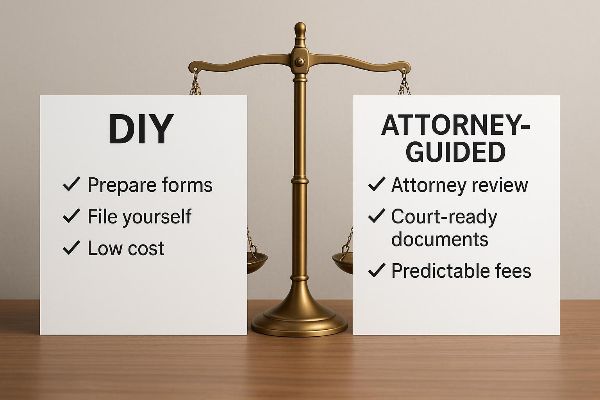
Tip: Even a DIY uncontested divorce can be complex. Oregon’s court system provides resources like the Guide & File program and family court facilitators in some counties who can check forms for completeness. If you’re unsure about any step, consider consulting an attorney for limited-scope help. For example, Pacific Family Law Firm offers flat-fee services to review documents or even handle the paperwork for uncontested divorces, ensuring nothing is overlooked. Additionally, an online platform like Unlink Legal can guide you through a do-it-yourself divorce with attorney-designed software – a good middle ground for those who want convenience but also the reassurance of legal expertise.
By following this checklist and utilizing available resources, you can confidently navigate your uncontested Oregon divorce from start to finish. Good luck with your fresh start!